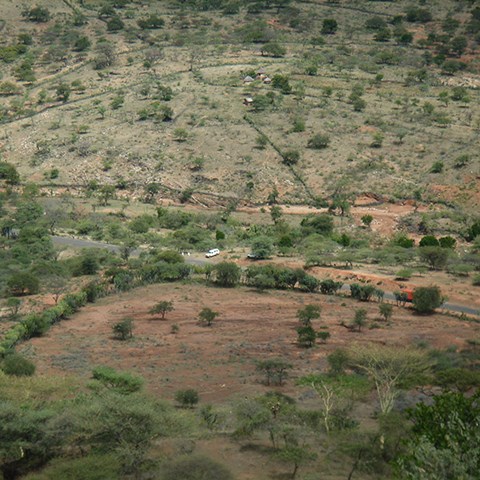
Drylands Transform is the new interdisciplinary research project starting up in the border region between Uganda and Kenya. The research team –coordinated by SLU – wants to modify the ongoing negative spiral of land, livestock and livelihood degradation into a positive transformation. The project aims to contribute to several of the United Nations global sustainable development goals.
Drylands cover 40% of the global land area and hosts 2 billion people of which 90% live in low- or middle-income countries. Drylands often face severe land degradation, low agricultural productivity, rapid population growth, widespread poverty and poor health. Livestock-based livelihoods, largely depending on seasonal migration are the norm.
Vulnerable to climate change
People and land are highly vulnerable to climate change, while there are also changes in land tenure, insecurity/conflicts and rapid infrastructure growth. Governance structures and institutions are often eroded.
In Drylands Transform we will investigate the links between land health, livestock-based livelihoods, human well-being, and land management and governance. We will contribute with new knowledge for transformative change and sustainable development of rangelands in the drylands of East Africa.
Stakeholder engagement
Through strong stakeholder engagement in interdisciplinary research, we set out to explore the challenges and pathways towards a social-ecological transformation in drylands that optimizes synergies among the sustainable development goals (SDGs) while minimizing the trade-offs. We will use innovative field research approaches focusing on livelihood improvement through rangeland restoration and governance interventions in some counties in the border region between Kenya and Uganda.
Sustainable development goals
The entry point of Drylands Transform is the urgent need to identify and enhance synergies between food and nutrition security (sustainable development goal, SDG, 2), land and ecosystem health (SDG15) and peaceful and inclusive societies (SDG16) for sustainable dryland development, while minimizing trade-offs between agricultural productivity (SDG2), natural resources management (SDG15) and climate change (SDG13). Interactions between the above SDGs and good health and well-being (SDG 3), gender equality (SDG 5) and access to clean water and sanitation (SDG6) will also be analysed.
For more information, please contact
Professor Ingrid Öborn
Department of Crop Production Ecology, SLU
ingrid.oborn@slu.se
Ylva Nyberg
Department of Soil and Environment, SLU
ylva.nyberg@slu.se
More SLU researchers in the project
Aida Bargués Tobella, Department of Forest Ecology and Management
Ewa Wredle, Department of Animal Nutrition and Management
Gert Nyberg, Department of Forest Ecology and Management
Göran Bostedt, Department of Forest Economics
Researchers from other universities/organisations in the project
Per Knutsson - School of Global Studies, Gothenburg University
Barbara Schumann - Department of Epidemiology and Global Health, Umeå University
Agneta Hörnell - Department of Food, Nutrition and Culinary Science, Umeå University
Kristina Lindvall – Department of Epidemiology and Global Health, Umeå University
Stephen Mureithi - Department of Land Resource Management and Agricultural Technology (LARMAT), University of Nairobi, Kenya
Denis Mpairwe – Department of Agricultural Production, Makerere University, Kampala, Uganda
Alice Turinawe - Department of Agribusiness and Natural Resource Economics, Makerere University, Kampala, Uganda
Dereje Wakjira – Resilience and Pastoralism, Intergovernmental Authority on Development (IGAD), Nairobi, Kenya
Leigh Winowiecki – Land Health Decisions, World Agroforestry (ICRAF), Nairobi, Kenya
Tor-Gunnar Vågen – GeoScience lab, World Agroforestry (ICRAF), Nairobi, Kenya
Drylands Transform 2020-2024
In Drylands Transform we will:
- Assess land health at the landscape scale and explore the links with human health and well-being
- Co-develop sustainable rangeland management options with local communities, and set-up knowledge sharing hubs (‘livestock cafés’)
- Study impacts of seasonality and climate variability on food and livelihood strategies, well-being and resilience.
- Identify innovative land governance mechanisms and practices that effectively address livestock-keepers’ dependence on both flexible and secure rights to land.
- Co-design and evaluate alternative scenarios for sustainable dryland transformation in East Africa with local and regional stakeholder groups.
The Swedish University of Agricultural Sciences (SLU) is leading the multidisciplinary team with researchers from Umeå University, Gothenburg University, University of Nairobi, Makerere University, World Agroforestry (ICRAF) and the Intergovernmental Authority on Development (IGAD).
This research project is funded by the Swedish Research Council, Formas, 2020-2024.
PUBLISHED: 02 DECEMBER 2020


 Posts
Posts


